Guides
This hub links the two long-form guides (label dose vs. trial dose, and claims and label rules), three blog posts, and four reference pages. It also adds standalone value: a five-step method for reading any Supplement Facts panel, and a glossary of eight terms those panels use but rarely define.
The longer reading, in one place
Most pages on this site answer one question: what is in this bottle, what does the label say, what does the research behind one ingredient actually show. This page is different. It collects the material that takes longer to read properly, and adds two short reference sections — how to read a Supplement Facts panel on any product, and a glossary of the words that panel uses without ever defining them.
Nothing here is new information dressed up twice. The two long guides and three posts below go deeper into topics this site covers elsewhere in shorter form, for anyone who wants the full arithmetic or the full regulatory background rather than a summary of it.
There is a real difference between the two formats. A guide walks through a whole subject end to end: every ingredient's dose, or the full legal picture behind one front-panel sentence. A post takes one finding and stays with it, because some findings, like what a single trial actually reported, deserve more room than a paragraph inside a longer page can give them. Neither format is a shortcut past the other; they answer different-sized questions.
The reference pages further down exist for a third reason: they are where the raw facts live, so a guide or a post can point to a number rather than restate it. If you already know which fact you need, skip ahead to whichever of the four reference pages holds it.
The two long guides
Both run long on purpose. Skimming either one will still tell you more than the front of the bottle does.
These two run long because the underlying subjects do. Eight ingredients each need their own dose comparison and their own trial-by-trial reading; a label claim needs its own federal rule, its own enforcement history, and its own careful separation from the disclaimer sitting next to it. Compressing either one into a few paragraphs would mean cutting the part that actually supports the conclusion.
Label Dose vs. Trial Dose
Every one of this label's eight ingredients, against the dose used in its own cited research, and what that research actually found. Several of the trials, including the largest, were negative even at the higher dose. Boswellia is the one exception, with a caveat of its own attached.
Read the guide →Joint Pain Claims and Label Rules
How US law separates a permitted structure/function claim from a prohibited disease claim, the FDA's own published example, a real FTC enforcement case, and a short method for reading any supplement label this way, applied directly to the front of this bottle.
Read the guide →Three shorter posts
Same standard of sourcing as the guides above, each focused on a single, specific finding.
A post is narrower on purpose. Each one takes a single finding that the two guides above only have room to mention and gives it the space to explain properly: one trial, one ingredient-versus-extract mix-up, one piece of guarantee arithmetic.
What the GAIT Trial Actually Found
A closer look at the largest glucosamine-and-chondroitin trial, run at doses higher than this label uses, and its mostly negative result, including the subgroup finding its own authors called exploratory.
Read the post →Turmeric Root Is Not Curcumin
Why a label that says "turmeric root" is not the same promise as a label that says "curcumin," and what that swap does to the actual dose reaching a capsule.
Read the post →The Sixty-Day Guarantee's Thirty-Day Window
How a 60-day guarantee and a 30-day minimum-use condition combine into a real window closer to 30 days than 60, and why that matters most on the six-bottle kit.
Read the post →The four pages the guides build on
These four pages carry the facts the two guides above draw on. If a guide sends you looking for the underlying number, it is usually one of these. Between them they hold the panel as printed, the source and studied dose behind each of the eight ingredients, the allergen and drug-interaction warnings, and what the thirteen marks on the artwork do and do not certify. Read any one on its own; the guides exist to connect them, not to replace them. A guide can tell you that an ingredient is under-dosed against its research; the reference page is where you check the exact amount for yourself, on this label or a different one.
Supplement Facts
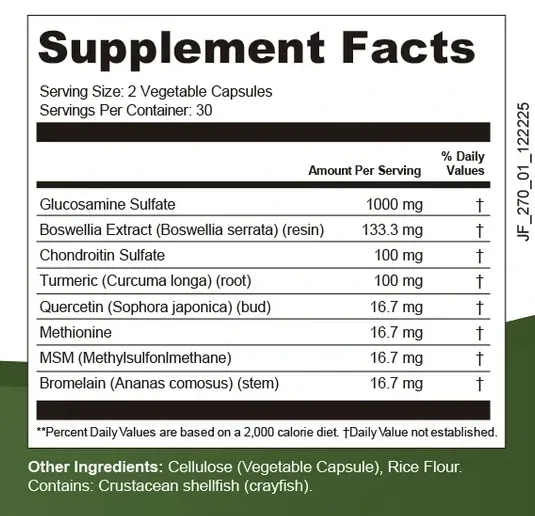
The full panel, transcribed line by line, with the total per serving and the two ingredients the retailer artwork leaves out entirely.
See the panel →Ingredients
Each of the eight, its source and part of the plant or animal it comes from, and the studied dose next to what this label actually supplies per serving.
See the ingredients →Side Effects
The shellfish allergen, the warfarin interaction, and what each ingredient's own safety literature says at its studied dose, not this label's smaller one.
See the risks →Testing and Quality
What each of the thirteen marks on this label's artwork actually certifies, and why no independent certificate of analysis is published for this product.
See the seals →How to read any Supplement Facts panel in five steps
The method below works on any Supplement Facts panel, not only this one. Five steps, in order, take a few minutes and tell you more than most of a sales page will, because a sales page is written to be read quickly and a panel is written to be checked slowly. Reading it in this order catches most of the ways a label can look more impressive than its own numbers support.
Find the serving size first
Every amount on the panel is per serving, not per capsule or per bottle. This label's serving is two capsules, so a one-capsule habit gets half the printed amounts.Check which amounts carry a dagger or no % Daily Value
A dagger next to an amount usually means no Daily Value is established for that ingredient. That is not a judgment on the amount; it means there is no official reference figure to compare it to at all.Read what form each ingredient is in
"Turmeric root" and "curcumin extract" are not the same ingredient, and neither are "glucosamine sulfate" and "glucosamine hydrochloride." The form is usually printed in parentheses; it changes what research actually applies.Look for a standardization or extract ratio
An extract standardized to a stated percentage of an active compound is a specific, checkable claim. An extract with no standardization figure at all is telling you less than it looks like it is.Add up the total, then compare it to what you expected to pay for
A long ingredient list with a small total milligram count usually means several ingredients are present at fractional amounts. The total on this label's own panel is covered on the Supplement Facts page.
Five steps sounds slow for something you do in a checkout aisle, but each one takes about ten seconds once you know what you are looking for. The habit is what matters, not the speed: once you have read one panel this way, every other one on every other shelf gets faster.
A short glossary for the words this label uses
Each of these terms appears somewhere on this site. Here they are in one place, in plain language.
None of these eight words is complicated once it is defined, and none of them is defined on a typical label or sales page. A structure/function claim is a legal category, not a marketing phrase, and the FDA's own rule is what actually separates it from a disease claim. U.S. et al., 2000 Standardization and extract ratio sound similar and answer completely different questions. The dagger symbol is printed on this label eight times and explained nowhere near it. Reading past these words without knowing what they mean is exactly how a panel ends up looking more informative than it is.
| Term | What it actually means |
|---|---|
| Standardization | A guarantee that an extract contains a stated percentage of a specific active compound, such as boswellic acid content in a boswellia extract. Without it, two extracts with the same milligram amount can deliver very different amounts of the compound a trial actually studied. |
| Extract ratio | A figure like 10:1 meaning ten units of raw plant material were concentrated into one unit of extract. It describes concentration, not the amount of any specific active compound, which is why standardization and extract ratio answer different questions. |
| Daily Value (DV) | An official reference amount, set by regulators, used to calculate the % DV column on a nutrition label. Many ingredients on a joint-support label, including all eight on this one, have no Daily Value established, so no percentage can be calculated for them at all. |
| The dagger (†) | A footnote symbol pointing to the words "Daily Value not established." It means no official reference figure exists to compare the amount to, not that the amount is adequate or inadequate for any purpose. |
| Proprietary blend | A group of ingredients listed together under one combined amount, with no individual milligram figure given for each. This label does not use one; every ingredient here carries its own individual amount. |
| Certificate of analysis (CoA) | An independent lab's report on what a specific batch actually contains, as measured, next to what the label claims. A lot number or CoA reference is not itself a certificate; the actual lab document is what would let a claim be checked. |
| Structure/function claim | A permitted statement that a product affects the body's normal structure or function, such as "supports joint comfort." It is a different legal category from a disease claim, which names a condition and promises relief from it. |
| Bioavailability | How much of an ingredient taken by mouth actually reaches the bloodstream in a usable form. An ingredient can be present at a meaningful dose and still deliver very little of it, if bioavailability is poor and no absorption enhancer is included. |
Worth noting on its own: this panel names every ingredient with its own individual milligram amount rather than hiding several behind one combined total. That is a genuine point in its favor on transparency, separate from whether any individual amount is dosed at a level the cited research supports.
What this reading is for, and what it isn't
None of this reading replaces a conversation with a clinician about a specific joint problem, and none of it is a substitute for reading the actual label on the actual bottle in front of you. What it should do is make that label easier to read critically, on this product or the next one, which is the only lasting use a guide like this has.
If you came here from a single guide or post and want the short version of everything else this site has found, the FAQ covers the product, the label, safety, buying and this website itself in one place, in shorter answers than any page linked above.
Guides: common questions
What's the difference between the two long guides on this site?
One is entirely about numbers: every ingredient's amount against its studied dose, and what each trial found. The other is entirely about words: what a supplement label is legally allowed to claim, and why an asterisk doesn't fix an unsupported claim.
What does the dagger symbol on a Supplement Facts panel mean?
It points to a footnote reading "Daily Value not established." That means no official reference amount exists to compare the ingredient to, not that the printed amount is enough or not enough.
What is a proprietary blend, and does this label use one?
A proprietary blend lists several ingredients under one combined total, with no individual amount for each. This label does not use one; all eight ingredients carry their own separate milligram figure.
Why does standardization matter more than the milligram amount sometimes?
Because an extract's milligram weight says nothing about how much of the specific active compound it contains unless the label also states a standardization percentage. Two extracts at the same weight can differ substantially in actual content.
Is a lot number the same thing as a certificate of analysis?
No. A lot number identifies a batch. A certificate of analysis is the actual lab document reporting what that batch was independently measured to contain. Having the first does not mean the second exists or has been published.
Where should I start if I only have a few minutes?
The five-step method on this page for reading any Supplement Facts panel, then the Supplement Facts page for this specific label's own panel.
Do the blog posts repeat the long guides?
No. Each post covers one specific, narrower finding in more depth than the guides have room for, rather than summarizing what the guides already say.
What is bioavailability, in plain terms?
How much of an ingredient taken by mouth actually reaches your bloodstream in a usable form. An ingredient can be present at a real dose and still deliver very little of it if bioavailability is poor and nothing on the label addresses that, which is a separate problem from the dose itself.
Keep reading
This label's panel, transcribed in full
The working example behind the five-step method on this page, line by line.
Read →The allergen and interaction warnings
The shellfish allergen and the warfarin interaction, both flagged plainly rather than buried.
Read →What thirteen seals actually certify
Including why no independent certificate of analysis exists for this product.
Read →Order JointBrex from the authorized retailer
60 servings per bottle, 1 to 2 droppers a day. Kits of 2, 3 or 6 bottles run from $49 a bottle on the sales page, with a 60-day money-back guarantee. Questions first? Call +1 (302) 200-3480.