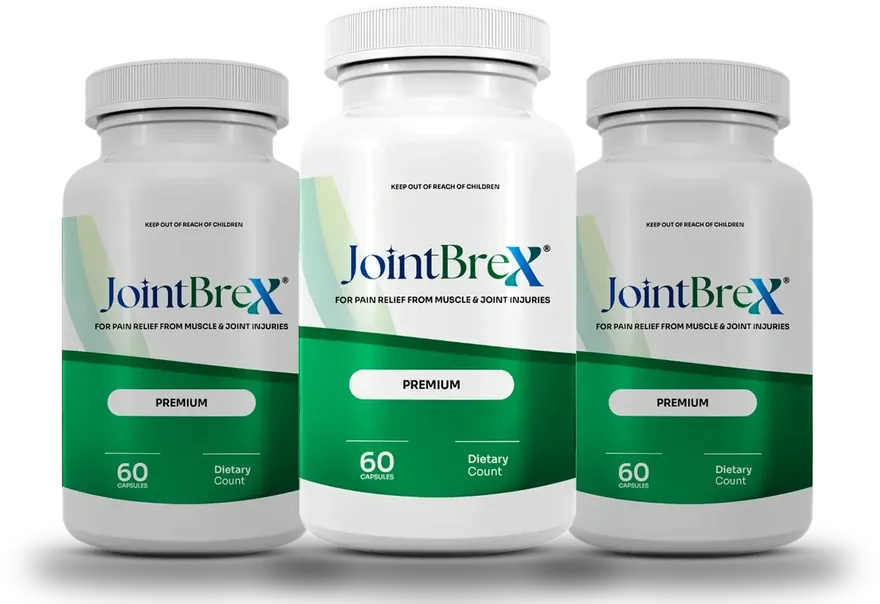
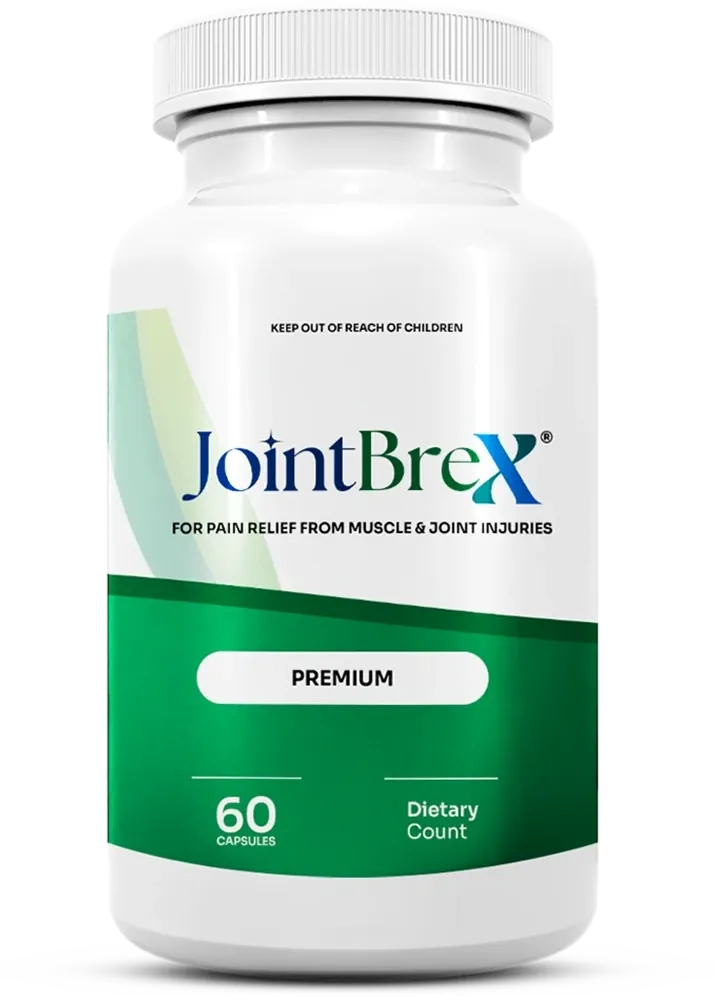
Label Dose vs. Trial Dose
Seven of JointBrex's eight ingredients sit below the dose used in the research cited for them, some by more than tenfold; boswellia is the exception. Several of those trials, including the largest, GAIT, and the bromelain trial, found no benefit even at the higher dose. A fraction of a dose is not zero, but nobody has tested these specific amounts.
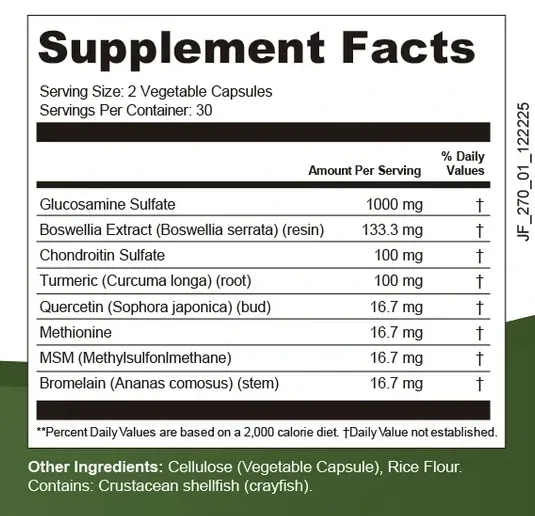
Eight ingredients, eight trial doses, and what each trial actually found
A milligram figure next to a trial dose is a fact you can check, for every line on the panel.
Eight ingredients are printed on this label, and each has a published human trial behind it somewhere in the literature. A trial dose is a number, this label's amount is a number, and dividing one by the other shows exactly where a serving of JointBrex sits against the research people cite to sell it.
This guide, and the full ingredient pages behind it, do that division eight times, then go a step further: what each cited trial actually found, because several found nothing at their own dose.
The bar is what this label supplies, against the daily amount the cited research used. The figure on the right is the fraction. One ingredient out of eight reaches the studied range, and it is the one nobody markets.
Boswellia Extract
In range133.3 mgper serving here100 to 250 mga day in researchTrials use 100 to 250 mg a day of extract standardised to boswellic acids. This amount fits. The label gives no standardisation.
Chondroitin Sulfate
1/12100 mgper serving here1,200 mga day in researchThe GAIT trial used 1,200 mg a day. This is one twelfth of it.
Glucosamine Sulfate
67%1000 mgper serving here1,500 mga day in researchGAIT used 1,500 mg a day of the hydrochloride form. European sulfate trials also run at 1,500 mg.
Turmeric root
1/5100 mgper serving here500 to 1,000 mga day in researchTrials use 500 to 1,000 mg a day of curcumin, not root powder. Root powder is roughly 0.6 to 3 percent curcumin.
Quercetin
1/3016.7 mgper serving here500 mga day in researchA published joint trial used 500 mg a day.
MSM
1/20216.7 mgper serving here3,375 mga day in researchAn osteoarthritis trial used 3.375 grams a day.
Bromelain
1/4816.7 mgper serving here800 mga day in researchA knee trial used 800 mg a day, and did not find a benefit at that dose.
Methionine
1/9016.7 mgper serving here1,500 mga day in researchA published methionine dose is 1,500 mg a day. Note this is plain methionine, not SAMe.
A fraction of a studied dose is not the same as nothing, and this chart is not an argument that the capsule is inert. It is an argument against expecting the result a trial reported, because the trial was not testing this much.
| Ingredient | This label | Dose used in the cited research | What that research found |
|---|---|---|---|
| Glucosamine Sulfate | 1,000 mg | 1,500 mg/day hydrochloride (GAIT) | No significant benefit over placebo overall; a subgroup result the authors called exploratory |
| Chondroitin Sulfate | 100 mg | 1,200 mg/day (GAIT); 800-1,200 mg/day (Cochrane pool) | GAIT: no benefit overall. Forty-three pooled trials: a modest benefit |
| Boswellia Extract | 133.3 mg | 100-250 mg/day, standardized to boswellic acids | Meta-analysis: significant improvement in pain and function, in standardized extracts |
| Turmeric (root) | 100 mg (an estimated 0.6-3 mg of curcumin) | 500-1,000 mg/day of curcumin | Meta-analysis: significant improvement, at curcumin amounts far above what this root powder yields |
| Quercetin | 16.7 mg | 500 mg/day | Reduced stiffness and pain, in rheumatoid arthritis, not osteoarthritis |
| Methionine | 16.7 mg | 1,500 mg/day | Raised homocysteine in a metabolic study; no joint trial of methionine itself found |
| MSM | 16.7 mg | 3,375 mg/day | A small improvement in function the authors called of uncertain clinical significance |
| Bromelain | 16.7 mg | 800 mg/day | No significant benefit over placebo, even at that higher dose |
Glucosamine and chondroitin: what GAIT actually found
Glucosamine and chondroitin are the two ingredients most people recognize on a joint-support label, and the trial behind both of them is the Glucosamine/chondroitin Arthritis Intervention Trial, known as GAIT. It is worth walking through in detail, because it is cited constantly and rarely read past its abstract. Clegg et al., 2006
GAIT enrolled 1,583 people with painful knee osteoarthritis across 16 centers and ran 24 weeks, comparing glucosamine hydrochloride, chondroitin sulfate, the two combined, celecoxib, and placebo. The doses were glucosamine hydrochloride 500 mg three times a day, 1,500 mg total, and chondroitin sulfate 400 mg three times a day, 1,200 mg total. This label supplies 1,000 mg of glucosamine sulfate, two thirds of the GAIT amount, and 100 mg of chondroitin sulfate, one twelfth of it.
Here is the part a dose comparison alone would miss: at those higher doses, GAIT did not find a benefit. About 60 percent of the placebo group hit the trial's pain-response mark, and neither glucosamine, chondroitin, nor the combination beat that rate by a significant margin. Celecoxib did, at around 70 percent. A smaller, exploratory slice of the group with moderate-to-severe pain, about a fifth of participants, showed a higher response rate on the combination, but the investigators themselves flagged that finding as underpowered, not as a result the trial was designed to confirm. A two-year structural follow-up of the same patients found the same pattern for joint-space loss on X-ray: no group, including celecoxib, slowed it in a way that met the trial's own bar for a meaningful difference. Sawitzke et al., 2008 So the honest sentence here is not just "this label is under-dosed": the largest trial of either ingredient, at higher doses than this label uses, mostly did not work either, except in a subgroup its own authors declined to treat as proof.
Chondroitin has one more piece of evidence that complicates the picture. A 2015 Cochrane review pooled 43 randomized trials, about 9,110 participants, mostly at 800 to 1,200 mg a day, and found a real, if modest, pain benefit, roughly 10 points on a 100-point scale over placebo. Singh et al., 2015 The reviewers also noted several of those trials were funded by chondroitin manufacturers, a reason for caution rather than dismissal. Two facts sit side by side: the single largest trial found nothing, and a larger pool of smaller trials found something modest, at a dose this label reaches neither way.
One caveat is a genuine open question, not a settled one. GAIT used glucosamine hydrochloride; this label, like earlier European trial literature, uses glucosamine sulfate. Whether that salt difference matters is disputed among researchers, and it is not resolved here. What is not disputed is the dose gap underneath it: 1,000 mg of the sulfate form is still below the 1,500 mg a day the sulfate literature uses.
Boswellia: the amount that actually fits, with one unanswered question
Boswellia extract is the one ingredient on this label that lands inside a range trials actually used: 133.3 mg, against 100 to 250 mg a day in a 2020 meta-analysis pooling seven randomized trials and 545 patients. Yu et al., 2020 That review found statistically significant improvement in pain, stiffness and function scores against placebo, with benefit showing up from around four weeks of use.
Why this one fits
Every pooled trial used an extract in roughly this range. On dose alone, this is the ingredient with the best case on this label.
The catch
The trials that worked used extract standardized to a stated boswellic acid content, commonly AKBA. This label gives no standardization figure for its boswellia extract.
A later trial adds a sober data point: a 2023 randomized study using an extract standardized to 12.5 percent active content found boswellia alone produced only modest pain reduction over eight weeks, less than a combination product tested alongside it. Even a properly standardized extract, in a recent controlled trial, did not produce a large effect.
The fair summary is two-sided. This is the one line on the panel where the milligram figure is not the problem. Whether this specific extract delivers the boswellic acid content the trials depended on is a question the label does not answer, and the testing and quality page covers why no certificate of analysis exists to answer it another way.
Turmeric root is not curcumin, and curcumin is not well absorbed
Turmeric is where the label's wording does real work against the reader. The panel says "Turmeric (Curcuma longa) (root)," 100 mg. Trials showing benefit for osteoarthritis are not trials of root powder; they are trials of curcumin, the specific compound in turmeric that is thought to be active, dosed at 500 to 1,000 mg a day. A 2019 meta-analysis of five randomized trials, 599 patients, found curcumin significantly improved pain and function scores at those doses, performing comparably to ibuprofen on both measures. Wu et al., 2019 That is a real, positive result. It is not a result about turmeric root, and it is not a result at this label's dose.
An analytic chemistry study measured curcumin content directly in nine commercial turmeric powder samples and found it ranged from 0.58 to 3.14 percent of dry weight, a roughly five-fold spread between the lowest and highest sample. Tayyem et al., 2006 Applying even the high end of that range to this label's 100 mg of turmeric root implies roughly 3 mg of curcumin in a full daily serving. Applying the low end implies closer to 0.6 mg. Either way, that is two to three orders of magnitude below the 500 to 1,000 mg of curcumin the positive trials used, and this label does not disclose which end of that range its own turmeric falls toward, so 0.6 to 3 mg is an estimate, not a printed fact.
There is a second gap stacked on the first. Curcumin absorbed on its own barely reaches the bloodstream. A foundational 1998 study gave human volunteers 2,000 mg of curcumin alone and found serum levels undetectable or very low; the same dose with just 20 mg of black pepper's piperine raised bioavailability about 2,000 percent. Shoba et al., 1998 This label discloses no piperine or other enhancer, so the small estimated curcumin content here is fighting poor absorption on top of a dose shortfall, not instead of it.
Turmeric root is not curcumin, and even a full curcumin dose is poorly absorbed without an enhancer. This label supplies a small fraction of a curcumin dose, in a form poorly absorbed at full strength, with no enhancer disclosed. Either gap alone would matter; together they are the widest shortfall on this panel.
MSM: a small trial effect, at two hundred times this label's dose
MSM, methylsulfonylmethane, is one of four ingredients on this label present at exactly 16.7 mg. The one randomized controlled trial located dosed knee osteoarthritis patients at 1.125 g three times a day, 3,375 mg total, for 12 weeks. Debbi et al., 2011 It found statistically significant improvements in physical-function scores against placebo, and the authors described the improvement as small, adding it was "yet to be determined" whether it was clinically meaningful.
16.7 mg is about half of one percent of the 3,375 mg dose that trial used. This is not a small dose against a large effect; it is a small dose against a small effect the researchers who found it were already cautious about, with no reason to expect any version of it at a two-hundredth of the amount.
Bromelain: the trial dose itself was negative
Bromelain is the clearest case on this label for a reason that has nothing to do with the dose gap. A randomized, placebo-controlled pilot study gave patients with moderate-to-severe knee osteoarthritis 800 mg a day of bromelain as an add-on to usual care, for 12 weeks, and found no statistically significant difference from placebo on the trial's primary outcome. The authors concluded plainly that bromelain "is not efficacious as an adjunctive treatment" at that dose. Brien et al., 2006
This label supplies 16.7 mg, about one forty-eighth of the 800 mg tested. Reaching the studied dose would not change the honest answer here, because that dose itself did not separate from placebo in the one dedicated knee trial available.
Quercetin: a real result, from a different condition, at a fraction of the dose
Quercetin's trial is real and its result is genuinely positive, with one detail the sales copy for a joint capsule tends to leave out: it was not a trial in osteoarthritis. A double-blind randomized trial gave women with rheumatoid arthritis, an autoimmune condition, 500 mg a day of quercetin for eight weeks and found reduced early-morning stiffness, less pain, and a significant drop in a plasma inflammation marker versus placebo, though joint swelling counts did not significantly differ. Javadi et al., 2016
This label's 16.7 mg is roughly 3 percent of the 500 mg studied dose, a thirtyfold gap on its own. Layered on top, the population that showed benefit had rheumatoid arthritis, not the osteoarthritis or general joint wear this product markets toward, which stretches the evidence a second way before the dose gap is even considered.
Methionine and the SAMe confusion
Methionine is worth separating from a name it is often confused with: SAMe, S-adenosylmethionine, a compound the body makes from methionine. Joint-health research studies SAMe, not methionine itself, and the two are not interchangeable ingredients on a label. This label lists plain Methionine, 16.7 mg, and no direct osteoarthritis or joint trial of oral methionine, as distinct from SAMe, was found in the literature checked for this guide.
The one placebo-controlled, double-blind trial of methionine itself dosed healthy adults and patients with chronic urinary tract infection at 500 mg three times a day, 1,500 mg total, for four weeks, and measured a significant rise in plasma homocysteine, a marker linked to cardiovascular risk in observational research, an effect the authors noted could be blunted by adequate folate intake. Ditscheid et al., 2005 That is a metabolic finding, not a joint-pain finding, measured at ninety times this label's dose. A federal research summary of osteoarthritis treatments discusses SAMe, not methionine, and calls that separate literature's own results inconsistent, a weak foundation even before the name gets swapped.
What a fraction of a dose fairly means, and what it does not
Seven numbers on this panel sit below the dose the cited research used, several by more than tenfold. It would be just as dishonest to round that down to zero as it would be to wave it away as a rounding error, so here is what can and cannot be said fairly about it.
- A fraction of a studied dose is not the same as no dose. Whether 100 mg of chondroitin does a tenth of what 1,200 mg does, or nothing measurable, is not something arithmetic alone can answer
- Ingredients are not necessarily acting alone. Nothing here rules out a small combined effect from eight compounds together that no single-ingredient trial was designed to detect
- Absence of a trial at 16.7 mg is absence of evidence, not evidence of absence. Nobody has published a study at these amounts, so nobody, including this guide, can say with certainty what they do
None of that changes the plainer fact underneath it. This label's doses were not matched to the research; the research exists at different, mostly higher, amounts. The honest sentence is not "this does nothing." It is that nobody has tested these specific amounts, so nobody, this product's marketing included, can actually tell you what they do.
That distinction matters for how you read the front of the bottle, too. A claim that a product provides "pain relief" is a claim with no trial run at this product's actual amounts behind it. What a supplement label is and is not allowed to say, and why an asterisk does not fix an unsupported claim, is covered on the label claims guide.
Label vs. Trial Dose: common questions
Which JointBrex ingredient actually reaches its studied dose?
Boswellia extract, at 133.3 mg against the 100 to 250 mg a day used in trials. Every other ingredient on the panel sits below its cited research dose, several by more than tenfold.
Did GAIT prove glucosamine and chondroitin work, even at a higher dose than this label uses?
No. GAIT used 1,500 mg of glucosamine and 1,200 mg of chondroitin a day and found no significant overall benefit over placebo. A smaller subgroup result was flagged by the trial's own authors as exploratory, not confirmed.
How much curcumin does 100 mg of turmeric root actually contain?
An analysis of commercial turmeric powders found curcumin content of 0.58 to 3.14 percent of dry weight, which applied to 100 mg of root implies roughly 0.6 to 3 mg of curcumin, far below the 500 to 1,000 mg of curcumin used in trials that found a benefit.
Does a below-trial dose mean an ingredient definitely does nothing?
Not necessarily. A fraction of a studied dose is not proven to equal zero, and ingredients may act together in ways a single-ingredient trial would not detect. Nobody has tested these specific amounts, so nobody can say what they do with certainty.
Was the bromelain trial dose itself effective?
No. The one dedicated knee osteoarthritis trial of bromelain used 800 mg a day and found no significant benefit over placebo. This label's 16.7 mg is a fraction of a dose that already failed to beat placebo.
Is the methionine on this label the same as SAMe?
No. SAMe is a compound the body makes from methionine, and joint research studies SAMe, not plain methionine. This label lists Methionine itself, and no direct joint trial of methionine was located.
Why does quercetin's trial not fully apply to this product?
The trial that found benefit used 500 mg a day, about thirty times this label's 16.7 mg, and it studied women with rheumatoid arthritis, not the general joint wear this product is marketed for.
Keep reading
Every ingredient, on its own page
The source, the amount and the studied dose for each of the eight, without the trial-by-trial detail this guide adds.
Read →The panel itself, transcribed line by line
The Supplement Facts panel as printed, including the two ingredients the retailer artwork never names.
Read →What the front of this bottle is legally allowed to say
The FDA rule on disease claims, the FTC's disclaimer guidance, and how both apply to this label's own wording.
Read →Order JointBrex from the authorized retailer
60 servings per bottle, 1 to 2 droppers a day. Kits of 2, 3 or 6 bottles run from $49 a bottle on the sales page, with a 60-day money-back guarantee. Questions first? Call +1 (302) 200-3480.