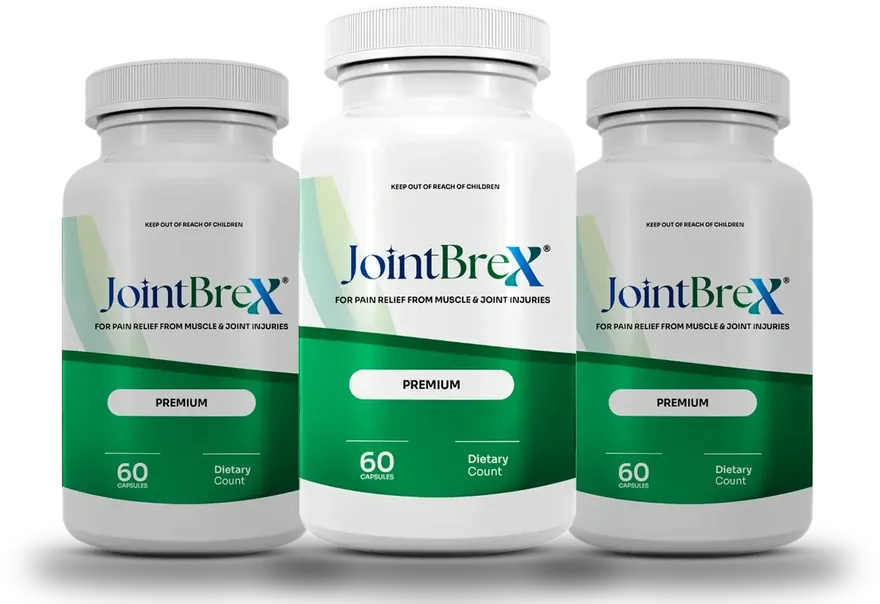
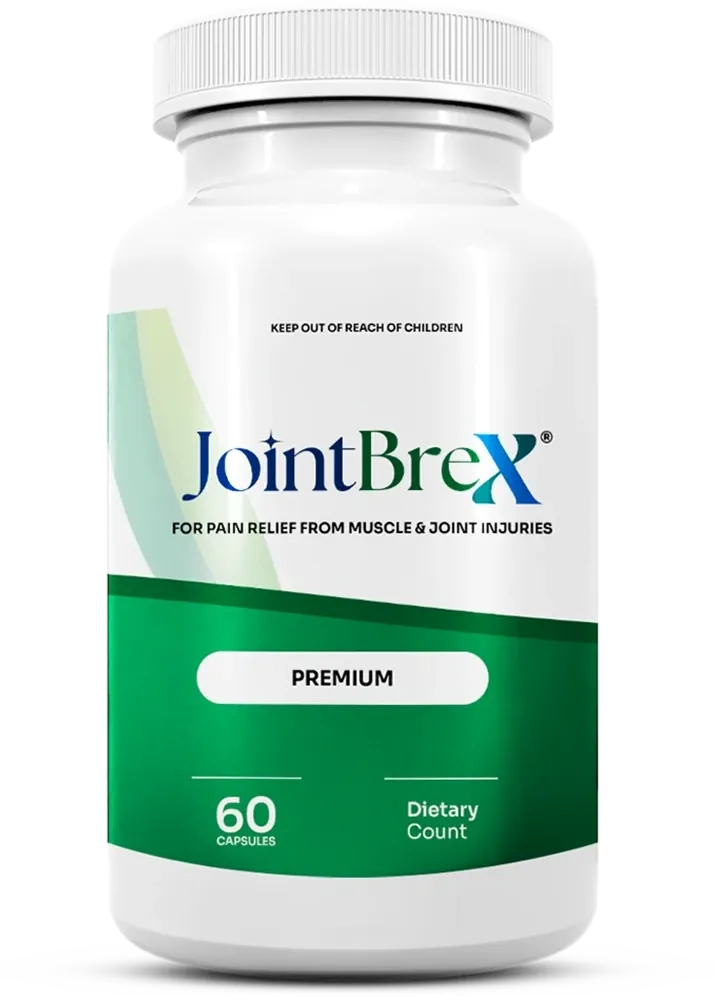
JointBrex Supplement Facts: Reading the Full Panel
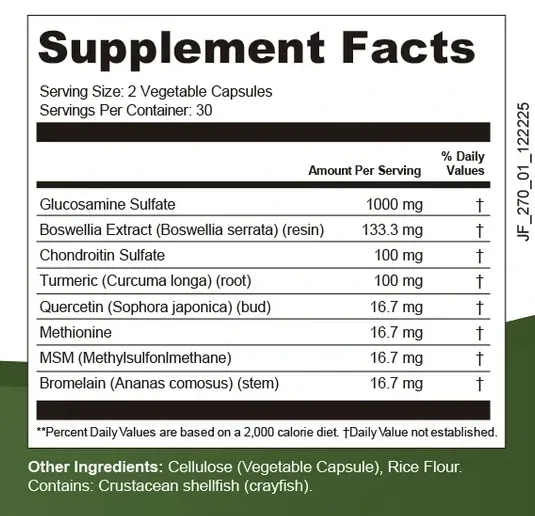
The JointBrex panel lists eight ingredients per two-capsule serving, about 1,384 mg in total.
Each one shows its own milligram amount, with no hidden blend. Other ingredients are cellulose and rice flour, and the label warns it contains crustacean shellfish.
See the ingredient guide for each one.
What the panel actually prints, line by line
Eight ingredients, one two-capsule serving, and a dagger next to every single one.
Serving size: 2 vegetable capsules. Servings per container: 30. Every amount below is what one serving, meaning both capsules taken together, supplies. There is no per-capsule breakdown printed anywhere, so if you ever split a dose and take one capsule at a time, you are getting half of each figure here, not the full amount.
The eight lines add up to about 1,400.1 mg. Glucosamine sulfate alone is 1,000 mg of that, nearly three quarters of the total. The remaining seven ingredients share what is left, and four of them are printed at the exact same figure, 16.7 mg, repeated four times.
| Ingredient | Amount per 2 capsules | % Daily Value |
|---|---|---|
| Glucosamine Sulfate | 1000 mg | † |
| Boswellia Extract (Boswellia serrata) (resin) | 133.3 mg | † |
| Chondroitin Sulfate | 100 mg | † |
| Turmeric (Curcuma longa) (root) | 100 mg | † |
| Quercetin (Sophora japonica) (bud) | 16.7 mg | † |
| Methionine | 16.7 mg | † |
| MSM (Methylsulfonylmethane) | 16.7 mg | † |
| Bromelain (Ananas comosus) (stem) | 16.7 mg | † |
| Total of the printed amounts | about 1,400.1 mg | — |
Every line on this panel carries the same footnote mark, a dagger, and every dagger points to the same sentence: no Daily Value is established. That means no government body has set an official reference amount for that ingredient, so the panel has nothing to calculate a percentage against. It is not a judgment that the amount is enough or too little. It is an absence of a yardstick, not a passing grade. For a yardstick, see how each amount compares with the dose used in research on the ingredients page.
Directions, caution and storage, exactly as printed
Two capsules a day, before a meal. The label says little else about timing.
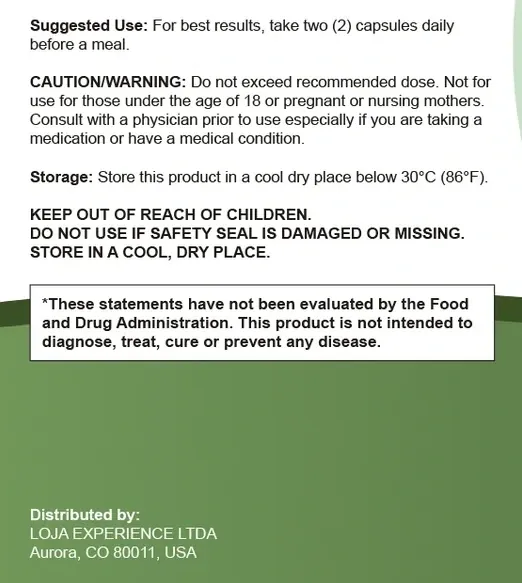
The label's own instruction is short: For best results, take two (2) capsules daily before a meal. Nothing on the panel names a time of day. Published listings for this product suggest taking the two capsules at the same time each day, which is sensible for a supplement you are trying to judge fairly, but it is a listing suggestion, not a label instruction.
Caution, as printed: Do not exceed recommended dose. Not for use for those under the age of 18 or pregnant or nursing mothers. Consult with a physician prior to use especially if you are taking a medication or have a medical condition.
Storage, as printed: Store this product in a cool dry place below 30 C (86 F).
Also printed on the label: KEEP OUT OF REACH OF CHILDREN. DO NOT USE IF SAFETY SEAL IS DAMAGED OR MISSING. STORE IN A COOL, DRY PLACE.
None of this is unusual for a capsule supplement. What is worth noting is what is missing: no time-of-day guidance, no note on taking it with or without other joint supplements, and no mention of what to do if you miss a day. The how to use page covers all three.
The serving math is at least internally consistent. Thirty servings a bottle, at two capsules a serving, is sixty capsules, which is what the bottle actually holds. Two capsules a day means one bottle covers thirty days, three bottles cover ninety, and six cover a hundred and eighty. Whatever else this label leaves unclear, the capsule count and the days-supply figure line up with each other.
Other ingredients, and the one allergen that is not a filler
Two inactive ingredients build the capsule. One active ingredient carries a shellfish source.
Below the eight active ingredients, the panel lists two more under "Other Ingredients": Cellulose (Vegetable Capsule), Rice Flour. These are not active ingredients and carry no dose of their own. Cellulose forms the vegetable capsule shell itself, which is why this product can be marketed as vegetarian in that one specific sense. Rice flour is a common filler, used to bulk out a capsule when the active ingredients alone would leave it under-filled or unevenly packed. Both are widely used in capsule manufacturing and neither is unusual to see on a supplement panel.
That vegetarian claim sits oddly next to the allergen line below it, though. A vegetable capsule shell does make the shell itself vegetarian, but the contents inside it are not: the glucosamine sulfate is drawn from crustacean shells. "Vegetarian" here describes the packaging, not everything that packaging contains, and the label does not spell out that distinction anywhere.
Contains: Crustacean shellfish (crayfish). This is printed separately from "Other Ingredients" because it is not describing a filler. It is describing the source of the glucosamine sulfate itself. Crustacean shellfish is one of the major allergens regulators require to be called out by name, and this label does that correctly. If you are allergic to shellfish, that single line is the only one on this page that should matter to you.
Six ingredients in the artwork, eight on the panel
The seller's own graphic and the label it sits next to do not count the same way.
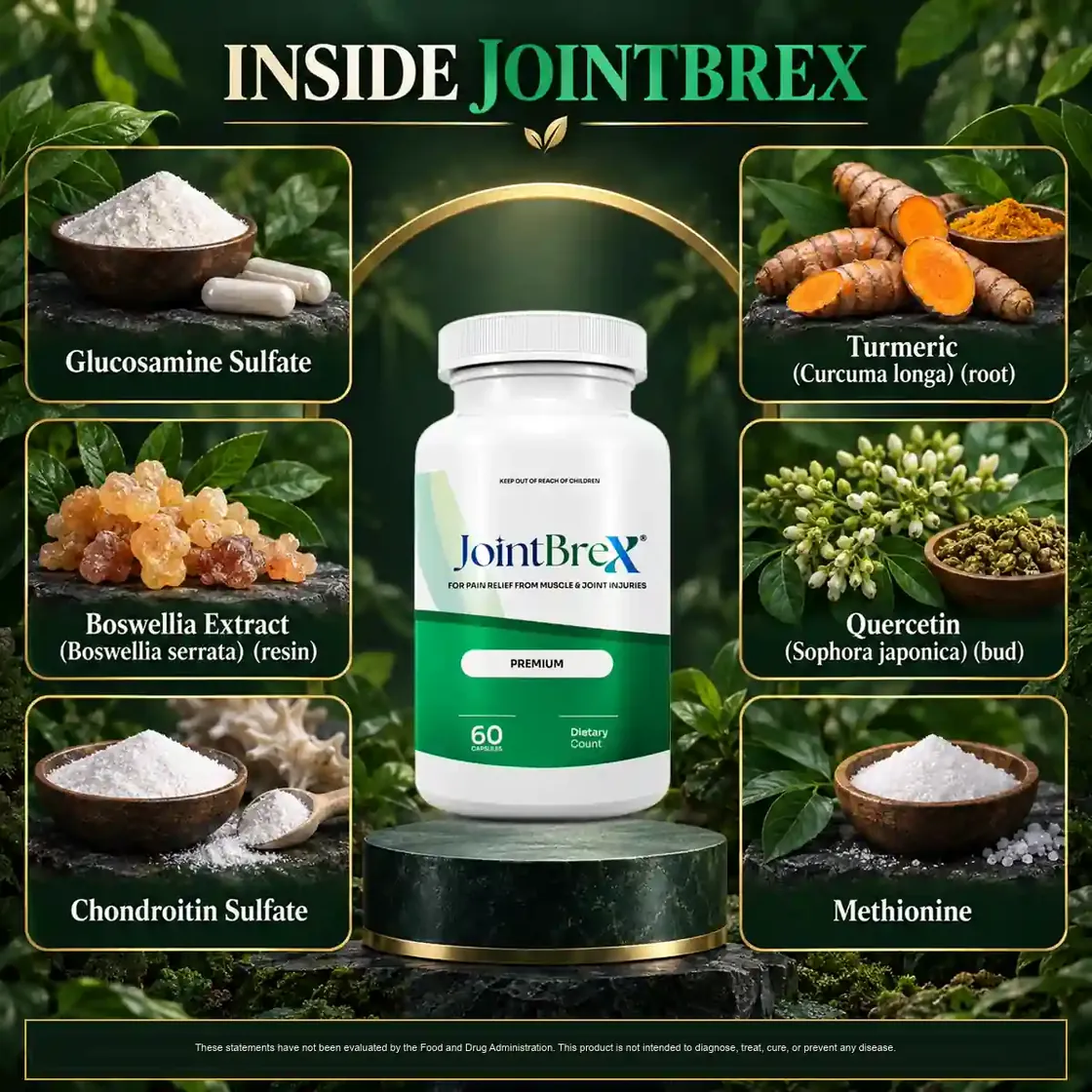
The retailer pack we worked from, and the seller's own "Inside JointBrex" artwork, names six ingredients: Glucosamine Sulfate, Boswellia Extract, Chondroitin Sulfate, Turmeric, Quercetin, Methionine. The Supplement Facts panel prints eight. It adds MSM (Methylsulfonylmethane) and Bromelain (Ananas comosus), each at 16.7 mg.
This is not necessarily a scandal. Marketing artwork is often finished before a formula is locked, or simplified to fit a fixed number of tiles in a graphic. Either explanation is ordinary in this industry. It is still worth stating plainly, because when two documents from the same company disagree about what is in the bottle, you need a rule for which one to believe. Our rule is simple: the Supplement Facts panel is the regulated document. The artwork is not. When they disagree, the panel wins, every time.
| Named in the seller's artwork | Printed on the Supplement Facts panel |
|---|---|
| Glucosamine Sulfate, Boswellia Extract, Chondroitin Sulfate | Same three, plus an amount for each |
| Turmeric, Quercetin, Methionine | Same three, plus an amount for each |
| Not shown in the artwork | MSM (Methylsulfonylmethane) and Bromelain (Ananas comosus), 16.7 mg each |
What a proprietary blend would have hidden, and why this panel does not
This label uses individual amounts, not a combined blend weight. That choice is worth crediting on its own terms.
A "proprietary blend" is a listing style some supplement labels use to name several ingredients together under one heading and print a single combined weight for the whole group, rather than a milligram figure beside each ingredient individually. It is legal, and it shows up across the supplement aisle, not just in joint products. It is also the format that makes it impossible to know how much of any one ingredient inside the blend you are actually getting, which means it is impossible to check that ingredient against any published research dose at all. A blend could, in theory, be mostly cheap filler with a token amount of whatever ingredient sells the bottle, and a reader would have no way to tell from the label alone.
| A proprietary blend label | This label | |
|---|---|---|
| What you see per ingredient | One combined weight for the group | An individual milligram figure for each of the eight |
| Can you check a research dose? | No, the individual amount is hidden | Yes, every figure is printed and checkable |
| Can a company hide a cheap filler inside the total? | Yes, that is the main criticism of this format | No, there is nothing to hide behind |
JointBrex does not use a proprietary blend anywhere on this panel. Every one of the eight ingredients gets its own line and its own milligram amount, including the four printed at 16.7 mg. That transparency is exactly what let this site build the comparisons on the ingredients page in the first place. A blend label would have hidden the low doses instead of disclosing them. This one discloses every amount, and disclosure is not the same as adequacy, but it is a real and checkable difference from a format built to obscure exactly this kind of shortfall.
What this panel does and does not tell you
A transparent panel is still just a list of amounts. What they do is a separate question.
- Every one of the eight ingredients is printed with its own milligram amount, not folded into a blend
- Every amount carries a dagger, meaning no Daily Value comparison exists for any of them
- The allergen line names crustacean shellfish specifically, tied to the glucosamine source
- The retailer's own artwork names six ingredients while the regulated panel names eight
Reading a Supplement Facts panel tells you what is in the bottle and how much. It does not tell you whether that amount does anything, or how each ingredient is supposed to act once you swallow it. Those are separate questions, covered on the ingredients page and the how it works page.
Supplement Facts: common questions
What is the serving size on the JointBrex label?
Two vegetable capsules, taken together as one serving. The bottle holds 60 capsules, which is 30 servings, and every amount on the panel is for that full two-capsule serving, not for a single capsule.
What does the dagger next to each ingredient mean?
No Daily Value has been established for that ingredient, so the panel has no official reference figure to measure the amount against. It does not mean the dose is adequate, and it does not mean it is inadequate. The comparison simply does not exist at a government level for any of these eight ingredients.
Why does the seller's artwork show six ingredients when the label lists eight?
The retailer pack and the "Inside JointBrex" artwork name six: Glucosamine Sulfate, Boswellia Extract, Chondroitin Sulfate, Turmeric, Quercetin, Methionine. The Supplement Facts panel adds MSM (Methylsulfonylmethane) and Bromelain (Ananas comosus) at 16.7 mg each. Marketing artwork made before a formula is finalized, or simplified for a six-tile graphic, are the two ordinary explanations. The panel is the regulated document, so it is the one to trust.
What are the 'other ingredients' in JointBrex, and are they allergens?
Cellulose (Vegetable Capsule), Rice Flour. Cellulose forms the vegetable capsule shell. Rice flour is a filler. Neither is a major allergen. The allergen risk on this label comes from the glucosamine sulfate itself, sourced from crayfish, and that is printed as its own separate line.
Does JointBrex use a proprietary blend?
No. A proprietary blend lists several ingredients under one combined weight, hiding how much of any single one you get. This panel prints an individual milligram amount for each of the eight ingredients instead, which is a genuinely more transparent format and the reason every amount on this site can be checked against published research doses at all.
What does the caution statement say?
Do not exceed recommended dose. Not for use for those under the age of 18 or pregnant or nursing mothers. Consult with a physician prior to use especially if you are taking a medication or have a medical condition. The label also carries a boxed instruction: KEEP OUT OF REACH OF CHILDREN. DO NOT USE IF SAFETY SEAL IS DAMAGED OR MISSING. STORE IN A COOL, DRY PLACE.
How should JointBrex be stored?
Store this product in a cool dry place below 30 C (86 F). That is the only storage instruction printed on the label.
Does the label carry an allergen warning?
Yes. Contains: Crustacean shellfish (crayfish). It is printed separately from the other-ingredients line because it describes the source of an active ingredient, not a filler. Anyone with a shellfish allergy should not take this product.
Keep reading
All eight ingredients, one at a time
The amount here against the dose used in research, what that research found, and the safety note for each.
Read →How to actually take the two capsules
Timing, consistency, what a missed dose means, and what not to stack this with.
Read →What is documented for each ingredient
GI upset, the warfarin interaction, turmeric's liver signal, and who should not take this at all.
Read →Order JointBrex from the authorized retailer
60 servings per bottle, 1 to 2 droppers a day. Kits of 2, 3 or 6 bottles run from $49 a bottle on the sales page, with a 60-day money-back guarantee. Questions first? Call +1 (302) 200-3480.