Turmeric Root Is Not Curcumin
Turmeric root powder is roughly 0.6 to 3 percent curcumin, so 100 mg of root supplies about 0.6 to 3 mg of actual curcumin. Osteoarthritis trials use 500 to 1,000 mg a day of curcumin extract, hundreds of times more. Curcumin is also poorly absorbed without an enhancer like piperine, which most root-powder labels do not include.
Why turmeric on a label and curcumin in a trial are not the same sentence
"Turmeric 100 mg" and "Curcumin 500 mg" read like two versions of the same fact. They are not. One is a weight of dried root powder. The other is a weight of one purified compound extracted from that root. Mistaking one for the other is the single most common way a joint-supplement label ends up looking better than the research it is standing next to.
Root powder and purified extract are different products
Turmeric is the whole dried, ground rhizome of the Curcuma longa plant, the same yellow spice used in curry. It contains curcumin, but curcumin is only one of many compounds in that powder, and it is a small fraction by weight, not the main ingredient.
"Turmeric (root)" on a label
A weight of the whole dried root powder. Most of that weight is fiber, starch and other plant compounds, not curcumin.
"Curcumin" on a label
A weight of a standardized extract, concentrated to contain a stated percentage of curcumin, often 95 percent or higher. This is what most osteoarthritis trials actually gave participants.
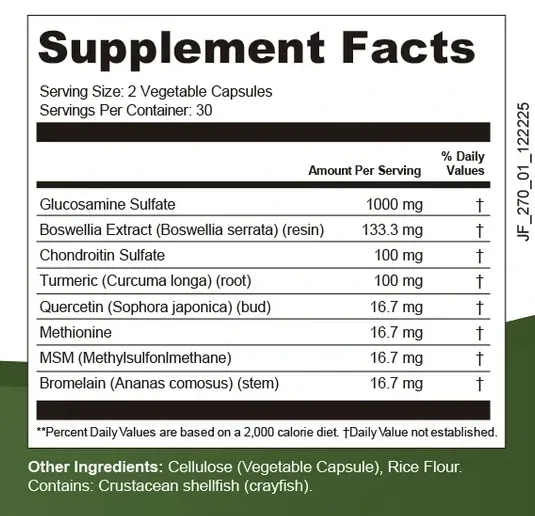
A label that prints "Turmeric (Curcuma longa) (root) 100 mg" is telling you the weight of the root powder, full stop. It is not telling you how much curcumin is inside that 100 mg, because it does not have to: nothing in supplement labeling rules requires a root-powder ingredient to also disclose its curcumin percentage.
Curcumin itself is also not one single molecule in casual use of the word. Turmeric contains a family of related compounds called curcuminoids, curcumin being the most abundant and most studied, alongside demethoxycurcumin and bisdemethoxycurcumin. A high-quality curcumin extract typically states what percentage of curcuminoids it contains and often breaks out curcumin specifically; a root-powder ingredient does neither, because measuring curcuminoid content is an analytic chemistry step nobody performs on a plain spice-grade powder before bottling it as a capsule.
Why a label would use root powder when the trials used extract
If curcumin extract is what the research actually used, a reasonable question is why any label would use root powder instead. The honest answer is mostly economics, not evidence.
Root powder is cheaper
Dried, ground turmeric root is a bulk agricultural commodity. A standardized curcumin extract, produced to a stated percentage and tested to confirm it, costs meaningfully more per kilogram to manufacture.
"Turmeric" reads as more natural
A word most people recognize as a cooking spice can sound gentler on a label than a chemical-sounding extract name, even when the extract is the ingredient with an actual trial behind it.
Neither reason is dishonest by itself, and plenty of legitimate food ingredients are exactly what they say they are. The problem is specifically when a root-powder ingredient sits on a label next to marketing language borrowed from curcumin's clinical research, implying a connection the milligram figure does not support. The ingredient can be turmeric. The claim behind it usually belongs to curcumin.
The arithmetic: what 100 mg of root powder actually contains
So how much curcumin is actually in 100 mg of turmeric root powder? This is a chemistry question with a published answer, not a guess.
A direct analysis of commercial turmeric and curry powders measured curcumin content across nine samples of pure turmeric powder and found it ranged from 0.58 percent to 3.14 percent of dry weight, roughly a five-fold spread between the lowest and highest sample tested Tayyem et al., 2006. Apply that range to a 100 mg serving and the arithmetic is straightforward.
| If curcumin content is... | Then 100 mg of turmeric root contains about... |
|---|---|
| 0.58% (low end measured) | 0.58 mg of curcumin |
| 1.5% (roughly the middle of the range) | 1.5 mg of curcumin |
| 3.14% (high end measured) | 3.14 mg of curcumin |
Even taking the most generous end of that range, 100 mg of turmeric root powder supplies somewhere around 3 mg of curcumin. That is the number a "Turmeric (root) 100 mg" line is actually delivering, once you do the multiplication a label is not required to show you.
What the trials actually gave people, and how far short a root-powder label falls
Curcumin's osteoarthritis research is built almost entirely on the extract, not the powder. A meta-analysis of five randomized controlled trials, covering 599 patients, found curcumin significantly improved pain and function scores compared with placebo, with results comparable to ibuprofen in the trials reviewed Wu et al., 2019. The doses behind that finding were 500 to 1,000 mg a day of curcumin or curcuminoid extract, taken as a standardized product, not as turmeric powder measured off a spice shelf.
Put the two numbers next to each other. Trials showing a benefit used 500 to 1,000 mg a day of curcumin. The arithmetic above puts 100 mg of turmeric root powder at roughly 0.6 to 3 mg of curcumin. That is not a modest shortfall. It is somewhere between about 170 times and over 1,600 times less curcumin than the low end of the studied range, depending on which curcumin-content figure you use.
The trials behind that meta-analysis measured improvement using WOMAC, a standard osteoarthritis scoring tool covering pain, stiffness and physical function, alongside a separate pain-specific visual-analogue scale. Both measures moved in favor of curcumin over placebo across the pooled studies, at doses that started at 500 mg a day and ran as high as 1,000 mg a day, taken daily for four to twelve weeks depending on the individual trial. None of the five trials tested a root-powder dose anywhere near 100 mg; the entire body of evidence behind this meta-analysis is an extract literature, not a spice-powder one.
The absorption problem underneath all of this
Even the milligram figures above are generous, because they assume every milligram of curcumin someone swallows actually gets absorbed into the bloodstream. It does not. Plain curcumin, on its own, is poorly absorbed, and this is not a minor caveat buried in a footnote; it is the specific problem an entire industry of "enhanced bioavailability" curcumin products exists to solve.
A foundational human study gave volunteers 2,000 mg of curcumin alone and found serum curcumin levels were undetectable or very low. When the same dose was given alongside just 20 mg of piperine, the black pepper compound, bioavailability rose by about 2,000 percent Shoba et al., 1998. That result is the reason piperine, or a lipid-based delivery system aiming at the same problem, shows up on so many curcumin labels.
A turmeric root-powder ingredient, with no disclosed piperine or other absorption enhancer, is missing the one addition the research shows meaningfully changes how much curcumin actually reaches circulation. That compounds the arithmetic problem above rather than offsetting it: a small amount of curcumin, already a fraction of a studied dose, is then absorbed even less efficiently than the extract used in the trials that found a benefit in the first place.
Piperine is not the only route formulators use to address this. Some curcumin products instead use a lipid-based delivery system, encapsulating curcumin in a fat-soluble carrier the body absorbs more readily than dry powder alone, or a phospholipid complex designed for the same purpose. Both approaches try to solve the identical problem the piperine study identified: curcumin on its own barely reaches the bloodstream. A label that names neither piperine, black pepper extract, nor a described delivery system alongside its turmeric or curcumin ingredient has not addressed that problem in any documented way.
A liver signal worth knowing about, wherever the turmeric comes from
Turmeric and curcumin supplements also carry a real, if uncommon, liver-injury signal worth knowing about before you decide how any of this arithmetic changes your own decision.
LiverTox, the NIH's clinical reference on drug-induced liver injury, describes the reaction as idiosyncratic and likely immune-mediated, linked to a specific gene variant present in more than 70 percent of reported cases versus 10 to 15 percent of the general population, with symptoms typically appearing one to four months after starting and progressing from fatigue and nausea to dark urine and jaundice National Institute of Diabetes and Digestive and Kidney Diseases (LiverTox), 2020. Separately, the NIH's complementary-health research center states plainly that plain turmeric is "likely safe in the recommended amounts for up to 2 or 3 months," but warns that highly bioavailable formulations, the kind combined with piperine or a lipid delivery system specifically to boost absorption, "may harm your liver" National Center for Complementary and Integrative Health (NCCIH), 2024.
Both sources point disproportionately to enhanced-bioavailability formulations as the versions linked to reported cases, not to plain turmeric root powder at ordinary amounts. A label with no disclosed absorption enhancer is a different risk profile from the products most case reports describe, but "different" is not the same as "zero," and fatigue, nausea, poor appetite, dark urine or yellowing skin while taking any turmeric or curcumin product are reasons to stop and get checked.
How to spot the root-versus-extract switch on any label
None of this requires trusting a stranger's arithmetic every time. Once you know what to look for, spotting a root-versus-extract switch on any joint or inflammation supplement takes about ten seconds.
Read the exact wording on the panel
"Turmeric," "Turmeric root" or "Curcuma longa (root)" means root powder. "Curcumin" or "Curcuminoids" named as the ingredient itself means an extract.Check for a standardization percentage
An extract worth comparing to research says something like "standardized to 95% curcuminoids." A root-powder ingredient almost never states one, because it isn't sold as a curcumin-delivery product in the first place.Do the multiplication before you compare it to a trial dose
Multiply the root-powder weight by roughly 0.6% to 3% to estimate curcumin content, then compare that number, not the root-powder weight, against the 500 to 1,000 mg extract doses used in research.Look for piperine or a delivery-system claim
Its presence suggests the formulator was targeting absorption specifically; its absence, on a plain root-powder ingredient, means the number you calculated in the step above is likely an overestimate of what actually reaches your bloodstream.
Try it on any label in your cabinet, not just a joint supplement. Turmeric shows up in inflammation, digestion and general wellness formulas across the supplement aisle, and the same switch happens in all of them: a small root-powder amount sitting next to language borrowed from curcumin's clinical research. The four steps above take about as long to run as reading the ingredient line itself.
A fraction of a studied dose is not the same as nothing
None of this proves turmeric root powder does nothing. Whole-food doses of spices have their own literature, separate from the concentrated-extract trials discussed here, and a small amount of curcumin is not the same claim as zero curcumin. What the arithmetic above does establish is narrower and harder to argue with: a label reading "Turmeric (root) 100 mg" is not describing the same substance, at the same amount, as the "curcumin 500-1,000 mg" used in the trials people cite when they talk about turmeric and joint pain. Reading the exact word on the panel, root or curcumin, is the whole trick.
The full ingredient-by-ingredient comparison for one specific label, including this exact turmeric calculation, sits on the ingredients page, and the wider pattern of label amounts against trial doses is laid out on the label dose versus trial dose page.
Questions readers ask
Is turmeric the same as curcumin?
No. Turmeric is the whole dried root powder; curcumin is one compound inside it, present at roughly 0.6 to 3 percent of the root's weight. A label naming "turmeric" is describing the root, not a curcumin dose.
How much curcumin is in 100 mg of turmeric root powder?
Roughly 0.6 to 3 mg, based on measured curcumin content of 0.58 to 3.14 percent in commercial turmeric powder Tayyem et al., 2006.
What dose of curcumin do osteoarthritis trials actually use?
500 to 1,000 mg a day of curcumin or curcuminoid extract, per a meta-analysis of five randomized trials Wu et al., 2019, hundreds of times more than a typical root-powder serving supplies.
Why does curcumin need piperine or black pepper?
Plain curcumin is poorly absorbed on its own. A foundational study found pairing it with 20 mg of piperine increased bioavailability by about 2,000 percent. A root-powder ingredient with no disclosed enhancer misses that boost entirely.
Can turmeric or curcumin hurt your liver?
There is a documented, uncommon liver-injury signal, disproportionately linked to high-bioavailability formulations combined with piperine or a lipid delivery system. Fatigue, nausea, dark urine or yellowing skin are reasons to stop and get checked.
How can I tell if a label uses root powder or a curcumin extract?
Read the exact ingredient name. "Turmeric" or "Curcuma longa (root)" means root powder. "Curcumin" or "curcuminoids," ideally with a stated standardization percentage, means an extract.
Does this mean turmeric root powder does nothing?
Not necessarily; whole-food spice doses have separate research from concentrated-extract trials. What's established is that a root-powder label and a curcumin-extract trial dose are not the same figure, and shouldn't be compared as if they were.
Where can I check a specific product's turmeric against this math?
The ingredients page walks through one label's exact turmeric amount using this same calculation, alongside its other seven ingredients.
Keep reading
60-Day Guarantee, 30-Day Window
A 60-day money-back guarantee with a 30-day minimum-use condition leaves about 30 usable days. Why that matters most on ...
Read →What the GAIT Trial Found
GAIT, the largest glucosamine and chondroitin trial ever run, found a negative main result. Here is the subgroup, the do...
Read →How much does JointBrex cost?
Three kit sizes, what each one supplies, and the two pricing details worth checking first.
Read →Order JointBrex from the authorized retailer
60 servings per bottle, 1 to 2 droppers a day. Kits of 2, 3 or 6 bottles run from $49 a bottle on the sales page, with a 60-day money-back guarantee. Questions first? Call +1 (302) 200-3480.