Single bottle1 Bottle30 days at two capsules
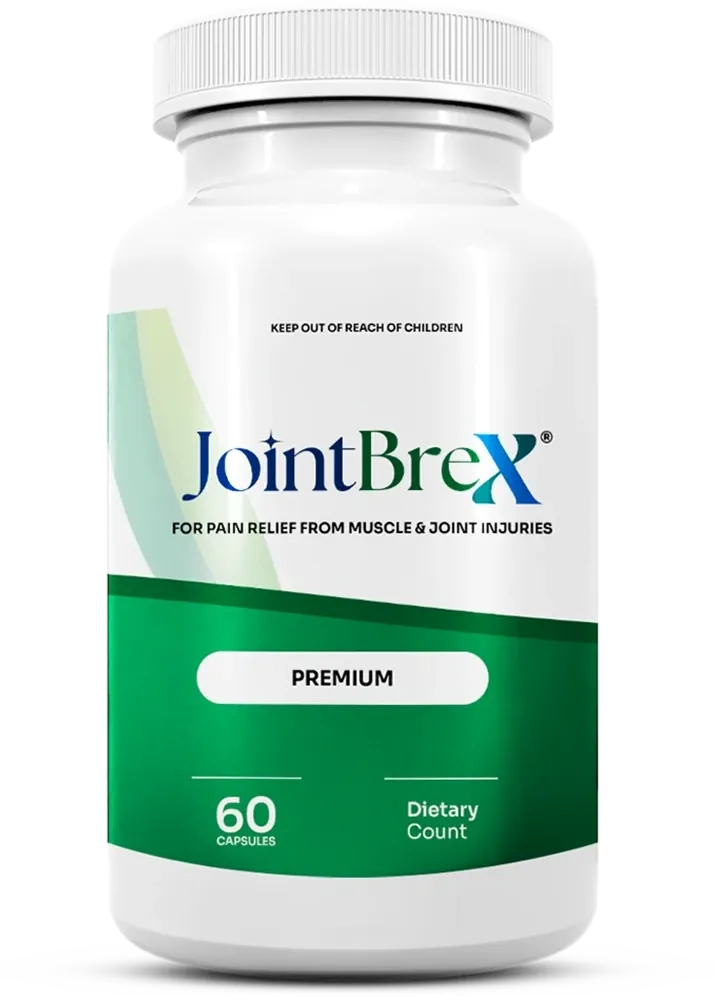
$89per bottle
Total $89
About $2.97 a day
- 60 capsules, 30 days at two a day
- Shipping charged at checkout
- No bonus guides

JointBrex is a dietary supplement capsule for everyday joint care.
Use case: Adults without a shellfish allergy take two capsules a day before a meal, and one 60-capsule bottle lasts 30 days.
How it works: Each serving has eight ingredients, led by 1,000 mg of glucosamine sulfate, with boswellia, chondroitin, turmeric root, quercetin, methionine, MSM and bromelain.
Published by Jointbrexcare, a US retail desk for JointBrex, not the manufacturer or the label distributor. Jump to the panel, the front-panel claim, the refund arithmetic or when to see a doctor, or call +1 (302) 200-3480.

 FDA Registered FacilityPlant listed on the FDA register, which is not approval
 GMP CertifiedManufacturing rules claimed, no certificate number shown
 Non-GMOA mark from the seller artwork with no certifier named
 All NaturalA marketing phrase with no legal definition
 USA markThe label prints no country of manufacture, only a Colorado distributor
JointBrex has eight ingredients: glucosamine sulfate 1,000 mg, boswellia extract 133.3 mg, chondroitin sulfate 100 mg, turmeric root 100 mg, and quercetin, methionine, MSM and bromelain at 16.7 mg each. One serving is two capsules, about 1,400 mg in total.
Eight ingredients, one serving of two capsules, and a total of about 1.4 grams. Here it is transcribed line by line.
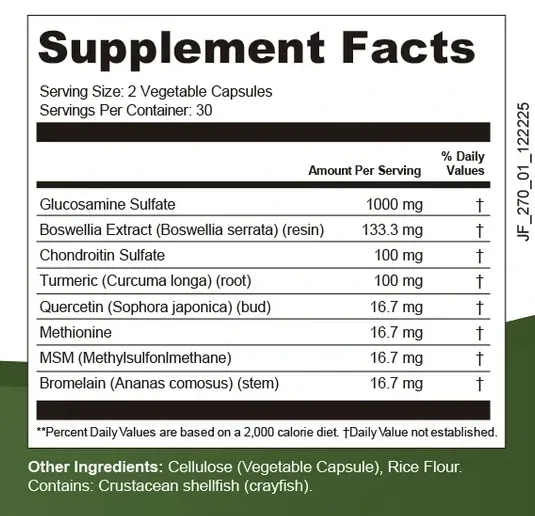
This is the document that matters. Everything else about a supplement — the badges, the bonus guides, the language about nourishing joint tissue — is written by a marketing department. The panel is the part the manufacturer has to stand behind, and it is the part we build this site around.
It lists eight ingredients per two-capsule serving, adding up to roughly 1,400 mg. Glucosamine sulfate at 1,000 mg is nearly three quarters of that total on its own. The remaining seven share the rest, and four of them — quercetin, methionine, MSM and bromelain — are at 16.7 mg each, which is the same figure repeated four times.
The retailer pack we work from names six: Glucosamine Sulfate, Boswellia Extract, Chondroitin Sulfate, Turmeric, Quercetin, Methionine. The label prints two more, MSM (Methylsulfonylmethane) and Bromelain (Ananas comosus). Where the two disagree we publish the label, because the label is the regulated document. We have asked why the pack is short and will print the answer here if one comes back.
No Daily Value is established for any of the eight, which is what the dagger symbol beside each amount means. It does not mean the amount is adequate or inadequate. It means there is no official reference figure to compare it to — so we compared it to the research instead, which is the chart below.
| Ingredient | Per 2 capsules | % Daily Value |
|---|---|---|
| Glucosamine Sulfate | 1000 mg | † |
| Boswellia Extract (Boswellia serrata) (resin) | 133.3 mg | † |
| Chondroitin Sulfate | 100 mg | † |
| Turmeric (Curcuma longa) (root) | 100 mg | † |
| Quercetin (Sophora japonica) (bud) | 16.7 mg | † |
| Methionine | 16.7 mg | † |
| MSM (Methylsulfonylmethane) | 16.7 mg | † |
| Bromelain (Ananas comosus) (stem) | 16.7 mg | † |
| Total of the printed amounts | about 1,400.1 mg | — |
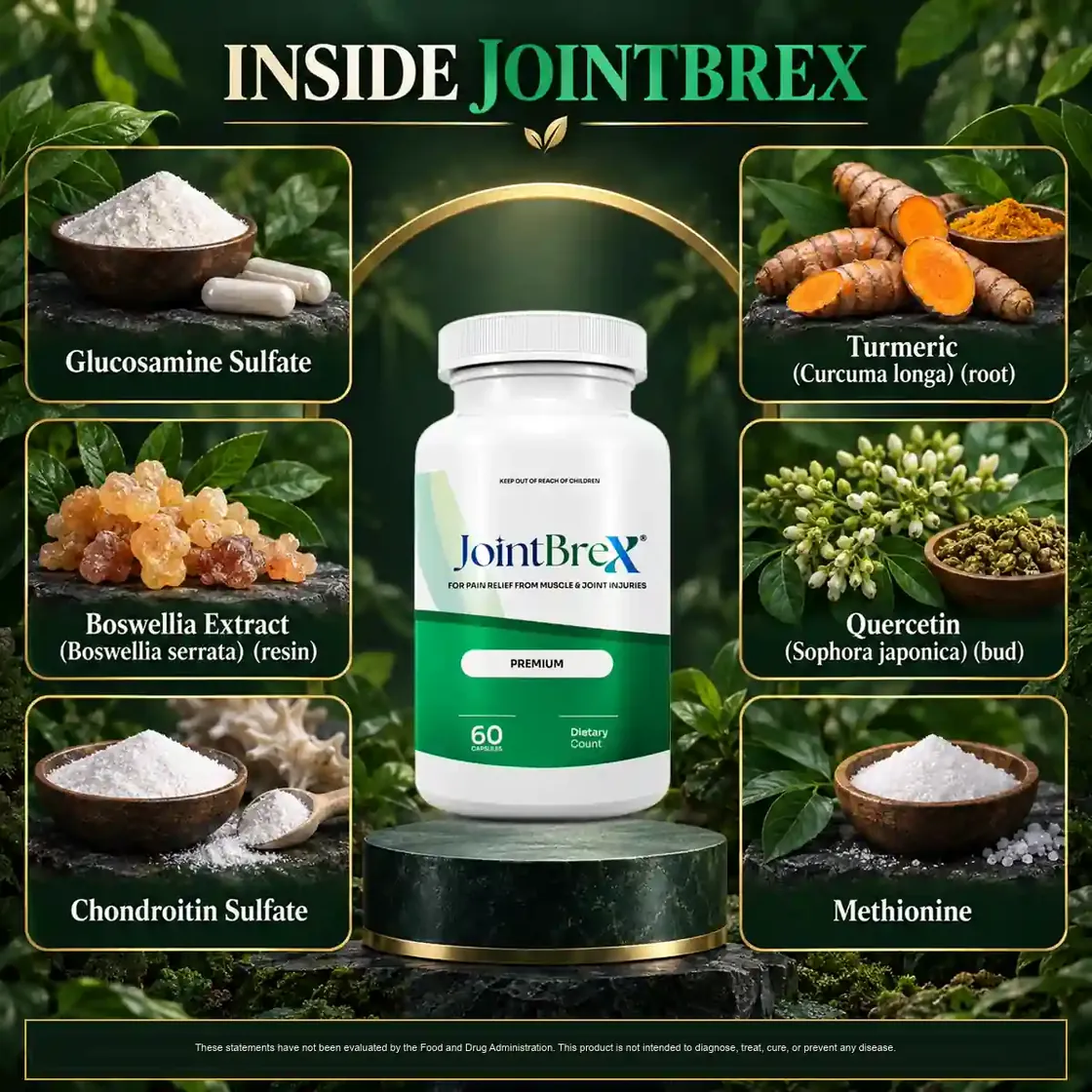
This is the image the seller uses to show what is inside the bottle. It has six panels: glucosamine sulfate, turmeric, boswellia extract, quercetin, chondroitin sulfate and methionine. MSM and bromelain are not in it, and they are on the Supplement Facts panel at 16.7 mg each.
This is not a scandal. Marketing artwork gets made before a formula is finalised, or gets simplified to fit six tiles, and either explanation is ordinary. It is worth saying out loud anyway, because it is the kind of small mismatch that tells you which document to trust when two of them disagree. The answer is always the panel.
The label prints Contains: Crustacean shellfish (crayfish). Glucosamine is commonly made from shellfish shells, and this one is. That warning is not decorative and it is not on the sales page we checked. It is on the bottle, and it is the single most important line on it for anyone with that allergy.
Only boswellia extract reaches the dose range used in research, at 133.3 mg against 100 to 250 mg. Glucosamine sulfate is 1,000 mg against 1,500 mg. The other six ingredients sit far below the amounts that studies used.
Seven of the eight ingredients arrive under the studied dose. Four of them arrive at less than a twentieth of it.
The bar is what this label supplies, against the daily amount the cited research used. The figure on the right is the fraction. One ingredient out of eight reaches the studied range, and it is the one nobody markets.
Trials use 100 to 250 mg a day of extract standardised to boswellic acids. This amount fits. The label gives no standardisation.
The GAIT trial used 1,200 mg a day. This is one twelfth of it.
GAIT used 1,500 mg a day of the hydrochloride form. European sulfate trials also run at 1,500 mg.
Trials use 500 to 1,000 mg a day of curcumin, not root powder. Root powder is roughly 0.6 to 3 percent curcumin.
A published joint trial used 500 mg a day.
An osteoarthritis trial used 3.375 grams a day.
A knee trial used 800 mg a day, and did not find a benefit at that dose.
A published methionine dose is 1,500 mg a day. Note this is plain methionine, not SAMe.
A fraction of a studied dose is not the same as nothing, and this chart is not an argument that the capsule is inert. It is an argument against expecting the result a trial reported, because the trial was not testing this much.
GAIT, published in the New England Journal of Medicine in 2006, ran 1,583 patients for 24 weeks on 1,500 mg of glucosamine and 1,200 mg of chondroitin a day. Overall, neither beat placebo. That is at doses higher than this label on both counts. Clegg et al., 2006
Curcumin trials use 500 to 1,000 mg a day of the extract. This label prints 100 mg of turmeric root, and published analysis puts root powder at roughly 0.58 to 3.14 percent curcumin. That is somewhere near 0.6 to 3 mg. Tayyem et al., 2006
Trials of boswellia extract run at 100 to 250 mg a day, and 133.3 mg sits inside that. The catch is that those trials used extract standardised to a stated boswellic acid content, and this label gives no standardisation figure at all. Yu et al., 2020
Every other page in this category prints the same eight words about supporting cartilage and easing stiffness. Those words are free to write and impossible to check. A milligram figure next to a trial dose is neither. It is the one comparison that tells you what you are actually buying, so it is the thing we put on the front page rather than three screens down.
The JointBrex front label says it is for pain relief from muscle and joint injuries. FDA rules do not allow a supplement to make that kind of claim. Research on its ingredients is mixed, and the largest trial found no benefit over placebo.
We quote the label because it is a fact about the product, and we correct it in the same breath.
FOR PAIN RELIEF FROM MUSCLE & JOINT INJURIES*
With an asterisk leading to the standard FDA disclaimer on the back.
“reduces the pain and stiffness associated with arthritis”
From the federal rule that separates a structure and function claim from a disease claim.
A claim to relieve pain from an injury is a claim to treat something. The disclaimer underneath does not convert it back into a permitted one: a regulator has said in terms that a disclaimer does not cure an unsubstantiated treatment claim. We quote the front of the bottle because it is a fact about the product, and we correct it in the same breath.
“Provide deep nourishment and intense support directly to joint tissues, where mobility and flexibility are regulated”
“Restore natural mobility and joint flexibility, eliminating the sensation of stiffness so you can move with confidence again”
“The result is less pain, less stiffness, and more freedom to move”
These are structure-and-function style sentences, but the front of the bottle is not.
Glucosamine, chondroitin, boswellia, turmeric and MSM have all been studied in joint pain. Results are mixed, the largest trial was negative, and the doses used were mostly higher than these. Boswellia has the most consistent signal of the eight and it is present here at a plausible amount. That is a fair description. ‘Pain relief from injuries’ is not.
Each JointBrex ingredient has its own card with the label amount, the dose used in research and a safety note. The glucosamine comes from shellfish and can interact with warfarin. Turmeric supplements have been linked to rare liver problems.
Tap through for the amount here, the amount used in research, the safety note and the sources.
glucosamine sulfate · amino sugar
The largest line, and still below the 1,500 mg used in the trials people quote. This label supplies 1000 mg of glucosamine sulfate per 2-capsule serving — below even the low end of studied glucosamine-sulfate doses (typically 1,500 mg/day) and well below GAIT's 1,500 mg/day glucosamine hydrochloride.
Boswellia serrata · resin
The one ingredient here whose amount lands inside the studied range, though no standardisation is given. This label's 133.3 mg of Boswellia extract (resin) falls within the broad range used in positive trials, which is more favorable than most other ingredients on this label — but every trial with a positive result used an extract standardized to a specific boswellic acid (commonly AKBA) content, and this label discloses no standardization at all, so the actual boswellic-acid delivery of this specific 133.3 mg cannot be verified from the label as printed.
chondroitin sulfate · connective tissue extract
One twelfth of the amount used in the largest trial of it. This label supplies only 100 mg of chondroitin sulfate per serving — one-twelfth of the GAIT trial dose (1,200 mg/day) and well below the range used in the Cochrane meta-analysis that found a real, if modest, pain benefit.
Curcuma longa · root powder
Root powder rather than a curcumin extract, which changes the arithmetic by a factor of thirty or more. The label lists 'Turmeric (Curcuma longa) (root)' — plain root powder, not a standardized curcumin extract.
Sophora japonica · bud
Joint research uses about thirty times this amount. This label's 16.7 mg of quercetin is about 3% of the 500 mg/day dose used in the trial showing benefit — a roughly 30-fold shortfall.
L-methionine · amino acid
Plain methionine, not the SAMe form that joint research actually studies. This label's 16.7 mg of methionine is roughly 1% of the 1,500 mg/day dose studied for methionine's own metabolic effects, and no direct osteoarthritis or joint trial of plain oral methionine (as opposed to SAMe) was located.
methylsulfonylmethane · organosulfur compound
Trials use grams. This is measured in tens of milligrams. This label's 16.7 mg of MSM is about 0.5% of the 3,375 mg/day dose used in the trial that found even a 'small,' of-uncertain-clinical-significance benefit.
Ananas comosus · stem enzyme
The one dedicated knee trial used 800 mg a day and did not find a benefit. This label's 16.7 mg of bromelain is about 2% of the 800 mg/day dose tested — and that 800 mg/day dose itself failed to beat placebo in the one dedicated moderate-to-severe knee osteoarthritis trial located.
Three bars means moderate human evidence: more than one controlled trial, with results that mostly point the same way. Two means limited. One means weak, or nothing directly on the joint question at all. The bars describe the ingredient at the dose researchers used, not at the dose on this label, which is the distinction the chart above is for.
See a doctor first for new joint pain after an injury, a hot or swollen joint, joint pain with fever, or pain that wakes you at night. Do not take JointBrex with a shellfish allergy, and ask first if you take warfarin.
Most of these are not subtle, and none of them is a supplement question.
There are published case reports of glucosamine raising INR in patients stable on warfarin — in one, from 2.3 to 4.7. Knudsen et al., 2008 If you take a blood thinner, this is a conversation with whoever manages your dose before you start, not after.
The 2019 ACR and Arthritis Foundation guideline for osteoarthritis strongly recommends exercise, weight management where relevant, and structured self-management programmes. It conditionally recommends against glucosamine and chondroitin. American et al., 2020
It cannot diagnose why a joint hurts. Osteoarthritis, inflammatory arthritis, gout, a meniscal tear and referred pain from elsewhere all present as a sore knee, and they are managed completely differently. A capsule taken for the wrong one is time lost.
Give it a defined trial with an end date, keep taking whatever your clinician prescribed, and write down what you are measuring before you start — stairs, distance, stiffness on waking. Then the 30-day refund window and your own evidence expire at roughly the same time.
JointBrex costs $89 for one bottle, $177 for three bottles ($59 each) and $294 for six bottles ($49 each). Each bottle holds 60 capsules and lasts 30 days. The three and six-bottle kits ship free in the US. Prices were checked on September 24, 2026.
Prices as published on the seller's page, checked September 24, 2026. Order links go to the official checkout.
$89per bottle
Total $89
About $2.97 a day
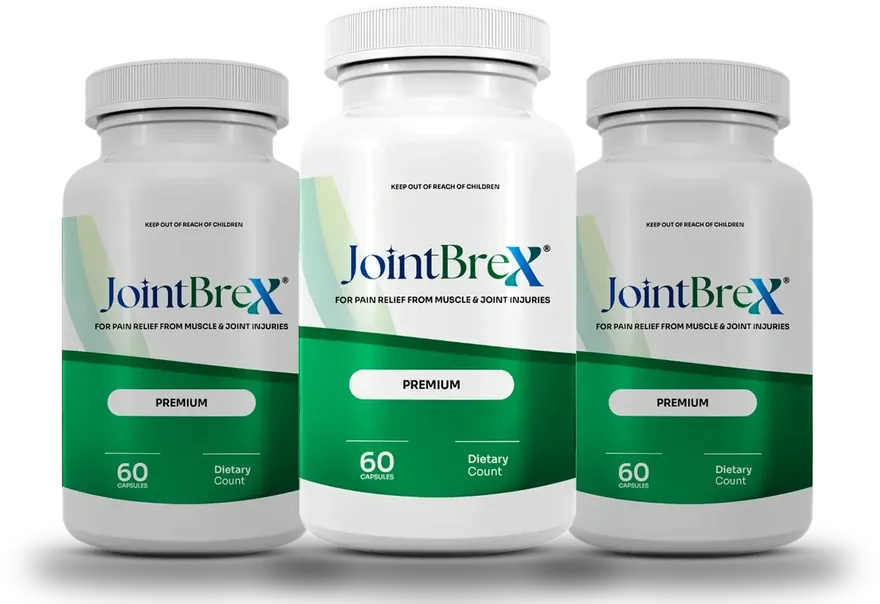
$59per bottle
Total $177
About $1.97 a day
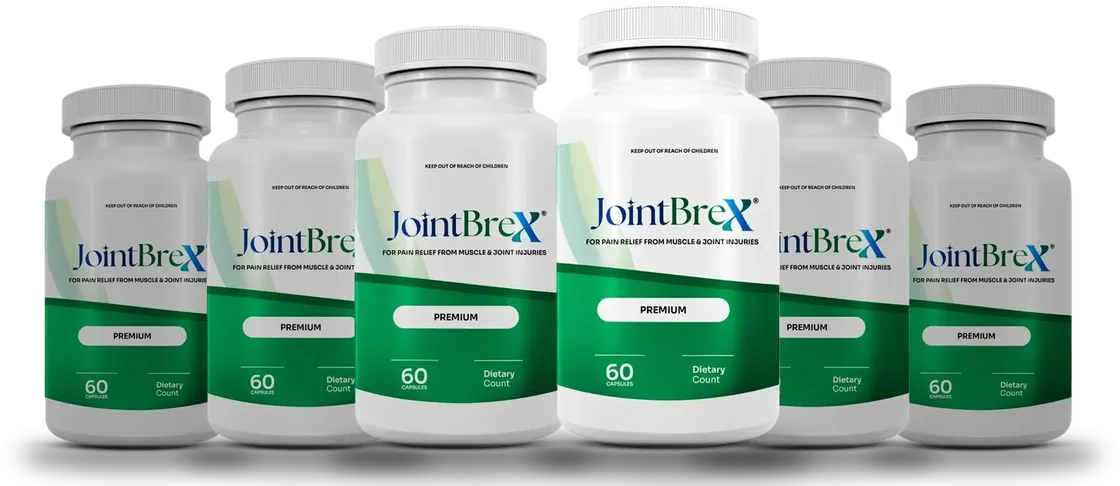
$49per bottle
Total $294
About $1.63 a day
Figures checked on September 24, 2026 against published listings. A bottle holds 60 capsules and a serving is two, so each bottle covers 30 days. Read the guarantee terms before you choose a size: the 60 days comes with a 30-day minimum-use condition. Questions go to the desk on +1 (302) 200-3480.
The 3-bottle kit is advertised at $59 a bottle, which multiplies to $177, while the same line also prints $207. Three times fifty-nine is one hundred and seventy-seven. We have flagged it rather than picked one. We show $177 above because that is what the per-bottle figure multiplies to, but check the total on the order form before you confirm, and keep the receipt.
The 3 and 6-bottle kits include five digital bonus guides: Nerve Renew Guide, Natural Nerve Recovery, Fortifying Vitamins, Renewed Nerves Challenge, Personalized Usage Guide. All five are nerve-health titles bundled with a joint product, which is a marketing decision rather than a clinical one. They are downloads, they have no cash value, and they should not be part of why you pick a kit size.
The JointBrex guarantee runs 60 days from the purchase date, but the seller also asks for 30 days of use first. That leaves about 30 days to ask for a refund. The buyer pays return shipping, so keep the receipt and use tracking.
Both halves are in the seller's own published terms. Together they make a shorter promise than the badge does.
Both halves come from the seller’s own published terms. The headline number is 60. The usable number is closer to 30, and on a six-bottle kit it closes while four bottles are still sealed. Work to the shorter figure and diarise it.
The 60 days run from the purchase date, not from delivery and not from the day you open the bottle. If shipping takes a week, that week is inside the window.
Email or call the order desk with your full name, email and order ID, then return to 5 Park Avenue, Floor 18, New York, NY 10016, USA. The buyer pays return shipping. Use a tracked service and keep the receipt. Refunds land 3-5 business days after the return is credited, then 5-10 days to show on the card.
The label and sales page leave several JointBrex facts unpublished, including the boswellia standardisation figure, the turmeric curcumin content, the country of manufacture and third-party lab results. We list each gap here and remove a line when it is answered.
Ten things we looked for and could not find, kept in one place rather than buried.
Ten open questions is not unusual for a supplement, and publishing them is not an accusation. It is the difference between a page that tells you what is known and a page that implies everything is. If any of these get answered, the answer goes here and the line comes off the list.
This site publishes no JointBrex customer reviews, star scores or order counts, because none could be verified. We will not invent testimonials. The reviews page explains this choice, so be careful with any rating you see elsewhere.
The review figures, star scores and order counts supplied to us were marked in the source material as layout copy — numbers to fill a template, not verified feedback from buyers. We could not verify a single one, so we publish none. There is no star rating anywhere on this site and there are no testimonials, because inventing them would be the easiest and most dishonest thing on this page. The reviews page explains that decision in full.
These JointBrex answers cover what it is, FDA status, ingredients, how to take it, shellfish and warfarin cautions, who should not take it, price and the guarantee. Each answer uses facts from the label and the seller's published terms.
JointBrex is a dietary supplement sold as capsules for everyday joint care. A bottle holds 60 vegetable capsules, a serving is two capsules, and one bottle lasts 30 days. The panel lists eight ingredients, about 1,400 mg per serving. It is not a drug.
No. The FDA does not approve dietary supplements. The seals on the artwork show that the plant is listed on the FDA register, which means the agency knows the plant exists. It is not an approval of this product, its formula or any claim made for it.
The label lists eight ingredients per two-capsule serving: glucosamine sulfate 1,000 mg, boswellia extract 133.3 mg, chondroitin sulfate 100 mg, turmeric root 100 mg, and quercetin, methionine, MSM and bromelain at 16.7 mg each. The other ingredients are cellulose and rice flour.
Take two capsules daily before a meal, as the label directs. That is the whole serving, so the amounts on the panel are daily amounts, not per-capsule amounts. Do not exceed the recommended dose. One 60-capsule bottle gives 30 days.
Yes. The label says Contains: Crustacean shellfish (crayfish), because the glucosamine is shellfish-derived. If you have a shellfish allergy, do not take this product. Keep the bottle out of reach of children and store it in a cool, dry place.
Ask whoever manages your warfarin dose first. Published case reports show glucosamine raising INR in patients who were stable on warfarin, in one case from 2.3 to 4.7. The label also advises you to consult a physician if you take any medication.
The label lists no side effects. This page notes a shellfish allergy risk from the glucosamine, a possible INR rise with warfarin, and rare liver problems reported with turmeric supplements. Consult a physician before use, as the label advises.
Do not use JointBrex if you have a shellfish allergy, are under 18, or are pregnant or nursing. Ask a physician first if you take any medication, including warfarin, or have a medical condition. Do not use it if the safety seal is damaged or missing.
Nobody can say honestly. Only boswellia reaches the dose used in research, and the largest glucosamine and chondroitin trial found no benefit over placebo. If you try it, set a defined period and measure something, because the refund window closes at about 30 days.
One bottle costs $89, three bottles cost $177 ($59 each) and six bottles cost $294 ($49 each), as published on September 24, 2026. The three and six-bottle kits ship free in the US and include five digital bonus guides. Shipping on one bottle is charged at checkout.
The guarantee is 60 days from the purchase date, with a 30-day minimum-use condition, so the real window is about 30 days. Returns go to 5 Park Avenue, Floor 18, New York, NY 10016, USA. The buyer pays return shipping. Use a tracked service and keep the receipt.
No. This site is run by Jointbrexcare, a US retail desk for JointBrex, not the manufacturer or the label distributor. The label names Loja Experience Ltda as the distributor. We earn a commission when an order completes, and we show label conflicts openly.